
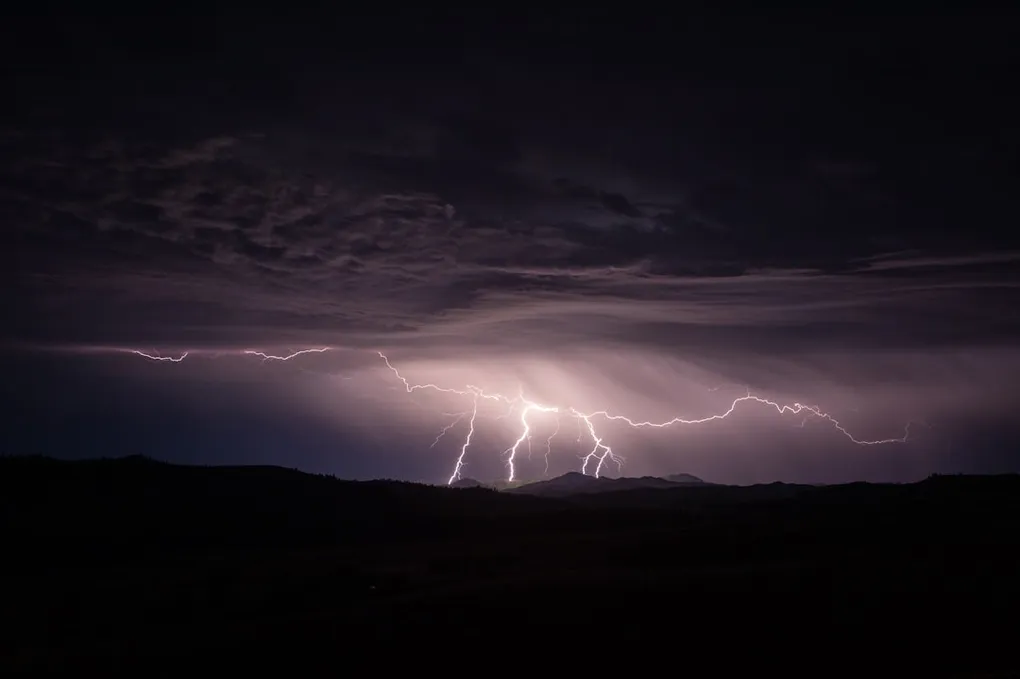
You’re halfway up a trail in the Beartooths when you hear it—the distant rumble of thunder. Within minutes the sky bruises purple, hail ricochets off granite, and every foot of elevation you fought for becomes a liability. Welcome to a Montana afternoon in July.
Because the Rockies jut into the jet stream and sit far from stabilizing maritime air, summer heating plus Pacific and Gulf moisture cook up cells that explode between 2 p.m. and 6 p.m. Hikers, already on exposed ridges or above-tree-line plateaus, make convenient lightning rods. This guide shows you how to read the sky, use the 30-30 rule, pick terrain that minimizes risk, and carry the small kit that turns a potential catastrophe into nothing worse than a soggy granola bar.
Understanding Montana’s Summer Storm Patterns
Mountain thunderstorms are solar-powered. Morning sunshine warms valley floors; warm air rides upslope winds into higher, cooler elevations where it condenses into towering cumulonimbus clouds. By early afternoon the billowing tops ice over, electrical charge separation begins, and the first bolt hits earth.
Peak season: June–August. Western ranges such as the Bitterroots and Glacier see 40–50 thunder-days per year; Central Montana’s Beartooth-Absaroka plateau averages 35; eastern plains drop to 20, but cells there move faster and can be equally violent.
Typical timeline: Cumulus 11 a.m., towering 1 p.m., first strike 2–3 p.m., storm motion 25–35 mph. A cell that looks tiny over the Swan Range can reach your ridge 20 minutes later.
Montana-specific quirks:
- Continental Divide acts like a 300-mile lightning rod; strikes concentrate on spines above 9,000 ft.
- High-based storms mean rain evaporates before reaching ground, so hikers underestimate the cell until the first bolt.
- Smoke from summer fires can cap convection, then suddenly break—storms explode with little visual build-up.
Recreation-area statistics (NWS 2010-2022): Glacier NP, 17 on-trail lightning injuries; Beartooths, 9; Bob Marshall, 5. All occurred between 1 p.m. and 7 p.m. at or near timberline.
Recognizing the Warning Signs
Before the Hike
Morning sky: A brassy, cloudless dawn with haze and building cumulus on the western horizon usually signals instability.
Apps: NWS Point forecast, BigSkyWeather.com hourly charts, and the National Lightning Detection Network all update faster than generic phone apps.
Red-flag phrases: “isolated afternoon storms,” “dry-line,” “shortwave trough.”
On the Trail
Visual: Cauliflower tops that broaden into an anvil, especially if the upwind edge is vertical and icy.
Audible: A faint, dry crackling in pines—static discharge.
Feel: Sudden 10°F drop, wind shifting 180°, western sky dark to the horizon.
Rule of thumb: If you can see vertical growth with the naked eye, the cell is maturing.
Flash-to-Bang
Count seconds between lightning and thunder; divide by five for miles. Thirty seconds = six miles. In Montana mountains, storms move toward you half the time; assume closure at 20 mph.
Immediate Danger Signs
Hair standing on end, metal pack-frame buzzing, metallic taste, or a blue corona on a trekking pole mean a strike is seconds away—act immediately.
The 30-30 Rule Explained
Seek safe shelter when flash-to-bang reaches 30 seconds (≈6 mi). Stay sheltered 30 minutes after the last audible thunder.
Why? Bolts can travel 10 miles out of the cloud, and “bolt-from-the-blue” is well-documented in Montana’s high-based storms. Because cells race along the jet, the second half of a squall line can arrive 25 minutes after the first. Resist the urge to resume the minute rain stops.
Lightning Position and Emergency Shelter
Best Shelter (Ranked)
- Hard-topped vehicle - Metal skin acts as Faraday cage
- Substantial building with plumbing/wiring
- Uniform stand of medium-height trees - No single emergent monarch
- Low, dry drainage away from lone boulders; insulate on dry pad or pack
Worst Places
Summits, knife-edge ridges, open meadows, isolated trees, picnic shelters, caves (entrance funnels ground current), lake shores, or anywhere you are the tallest object.
The Lightning Position (Step-by-Step)
- Drop metal objects 30 m away
- Crouch on balls of feet, heels together, knees bent, arms wrapped around legs
- Minimize ground contact—imagine a basketball between your feet
- Cover ears; thunder can rupture eardrums within 30 yd
- Remove metal jewelry—heating is trivial, but panic response causes injury
Why It Helps
Current traveling along the ground spreads outward; by minimizing contact area and keeping feet together, you reduce voltage differential across your body.
Group Protocol
Spread 15–20 ft apart so one ground strike won’t disable the entire party. If someone is hit, rescuers wait until danger has passed—lightning does not leave residual charge in victims.
Trail-Specific Advice for Popular Montana Hikes
Glacier National Park
Iceberg Lake: 5 mi gradual climb ends in an amphitheater with 2,000 ft walls—no place to hide. Be off the trail by 1 p.m.
Highline Trail: Multiple 7,000-ft benches; three marked bail-outs (Haystack, Granite Park, Swiftcurrent). Identify them on your map at breakfast.
Sun-Road spurs: Logan Pass parking is 6,600 ft; storms often obscure the road, delaying evacuation—carry rain gear plus warm layer.
Beartooth Mountains
Alpine Plateau: 20 miles of tundra above 10,000 ft. If clouds build before you reach the pass, turn back—descent to timberline is 4 mi minimum.
Granite Peak approaches: Froze-to-Death Plateau earned its name; bivouac sites are small and exposed. Summit and be below treeline by noon.
Bob Marshall Wilderness
Chinese Wall: 1,000-ft limestone face funnels updrafts; cells mature directly overhead. Nearest trailhead is 18 mi—satellite messenger essential.
Mission Mountains
Vertical relief 5,000 ft in 4 mi: Pacific moisture spills over the range by 3 p.m. Start at dawn, plan turnaround at 11 a.m.
Key takeaway: Calculate “storm time” just like mileage. If the forecast says 40% storms after 2 p.m., summit by noon and be below timberline by 1 p.m.—no exceptions.
Gear and Preparation
Essential Carry
- Small AM weather radio or inReach paired to NWS alerts
- Space blanket or ultralight tarp—insulation from wet ground reduces shock
- First-aid kit with non-adherent burn pads and ibuprofen
- Whistle and 200-lumen headlamp; storms often delay descent into darkness
Do NOT Rely On
- Trekking poles as “lightning rods” (myth—metal in your hand is irrelevant compared with the 30,000-amp main channel)
- Cell coverage (Glacier’s backcountry has <15% signal)
Pre-Hike Planning
- Check 3-day synoptic forecast; note CAPE (instability) values >500 J/kg
- Print topo; highlight every stretch >500 yd above timberline
- Early start—car at trailhead by 6 a.m.
- Share GPS track plus hard turnaround time with a responsible friend
If Someone Is Struck: Emergency Response
- Scene safety - Count 30 minutes from last thunder before exposing rescuers
- 911 or satellite SOS - Give UTM coordinates from GPS
- Lightning victims are safe to touch - No residual charge
- Primary survey - Airway, breathing, circulation. CPR success rate is high because the heart often stops in ventricular fibrillation
- Secondary - Treat for shock, cover burns with sterile dressing, splint fractures from muscle contractions
- Evacuation - Montana rescues use Two Bear Air, REACH, or military if civilian choppers are weathered-out. Nearest drivable trailhead speeds response more than exact mileage
- Document - Time of strike, symptoms, and treatments for EMS
Real Montana Lightning Stories
2019, Grinnell Glacier Trail
A father and daughter felt hair rise above 7,000 ft, immediately assumed lightning position; strike hit 100 yd away—no injuries, hike out delayed 45 min.
Lesson: Early recognition works.
2016, Froze-to-Death Plateau
A solo climber summited Granite Peak at 3 p.m.; storm arrived, one bolt knocked him unconscious. Satellite messenger summoned Two Bear Air; full recovery after two nights in ICU.
Lesson: Summit-by-noon rule ignored.
Ranger Quote (Glacier NP)
“Ninety percent of our lightning incidents occur after 2 p.m. on trails that start above 5,500 ft. An early start is the cheapest insurance you can buy.”
Lightning Safety Checklist
Montana’s afternoon storms are as predictable as sunrise—use that to your advantage. Smart hikers finish early, watch the sky, and value safety over summits.
Before Every Hike
- ☐ Checked BigSkyWeather.com and NWS point forecast
- ☐ Planned to summit by noon and be below timberline by 1 p.m.
- ☐ Practiced flash-to-bang count with partner
- ☐ Marked bailout points and timberline on topo
- ☐ Packed space blanket, first-aid, whistle, headlamp, inReach
- ☐ Group knows lightning position and 15-ft spacing rule
- ☐ Will turn around at first thunder, no debate
Critical Takeaways
Start early: Car at trailhead by 6 a.m., summit by noon, below treeline by 1 p.m.
Watch the sky: If you can see vertical cloud growth, the cell is maturing—start descending.
Use the 30-30 rule: Seek shelter at 30 seconds flash-to-bang, stay sheltered 30 minutes after last thunder.
Know your bailouts: Study the topo before the hike and identify safe retreat routes.
Don’t summit-fever: No peak is worth your life. Turn around at first thunder, every time.
Get hourly forecasts and storm tracking for Montana’s hiking areas at BigSkyWeather.com with real-time weather updates for Glacier, Beartooths, Bob Marshall, and all major trailheads. Check conditions before every hike!